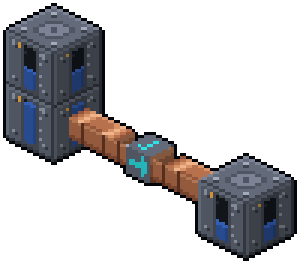
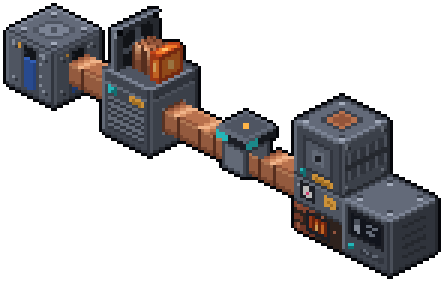
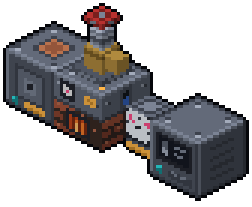
IN DEVELOPMENTminecraft 26.1.2 + 26.3 · neoforge · mit
A factory mod built on real process engineering. Build a plant of pumps, tanks, valves and controllers that behave like the real thing, then draw it as a real P&ID.
Setpoint adds the machines of a real process plant to Minecraft. You pump water from tank to tank, hold levels with control valves, run it all on power you make yourself, keep your boilers safe from overpressure and watch the whole plant from a control room. Later on: a distillation column.
plant.render
At the heart of it: the P&ID. Real plants are run from their piping and instrumentation diagrams. In Setpoint you build the plant first, then draw it: every pump, tank, valve and instrument becomes its symbol on a blueprint, with the pipes and the signal wiring between them.
Easy by default, depth if you want it. Every machine works the moment you place it. Pumps start by themselves, controllers find their own valve and hold the tank at 50 %. No process engineering degree needed.
Underneath runs real physics: pump curves, cavitation, valve resistance and PID control. You can ignore all of it, or dive in and tune every loop yourself.
And you can hear your plant: pumps hum, turbines whine higher as they spin up, fireboxes crackle. Quietly, and only up close.
NOTESetpoint 0.2.4 is out, made for modpacks: a config for pack makers, oil that works with other mods, and keys that never clash. For Minecraft 26.3 and 26.1.2: pick the file for your Minecraft version. Back up your world before you update to a new version. Download it on CurseForge; the source is open (MIT) on GitHub.
// 02 p&ids · the core
Draw your plant
A P&ID (piping and instrumentation diagram) is the map of a real process plant. Every operator learns to read one. In Setpoint you draw your own, straight from what you built.
1Right-click the ground with a blank P&ID: the first corner.
2Look at the opposite corner. The box shows in the world in cyan, ten blocks high.
3Right-click it. Your plant comes out as a P&ID; the blank sheet is used up.
4Right-click the P&ID: name it, and read the drawing.
Done
SETPOINT P&ID
The in-game screen, redrawn from the same pixel symbols. Type a name, and hover a symbol for its tag.
The symbols
Setpoint draws the standard P&ID shapes as pixel art. Pumps and valves turn with the real block. The drawing looks from above, so an instrument hidden under something bigger, like a safety valve on a boiler, is drawn in the free cell next to it. Big equipment, like the distillation column, the floating roof tank and the gas sphere, is drawn over its whole footprint. The emergency stop and the alarm beacon have their own symbols, and light up on the live drawing when they go. Power cables are drawn as dotted purple lines beside the pipes, so a cable under a pipe still shows.
Live on the console
The first job for your P&IDs: right-click a DCS console with one and its P&ID tab shows the drawing live. Running equipment turns cyan, tanks fill up to their real level, amber needs attention and alarms flash magenta. Grey means the console cannot see it: gone, or more than 32 blocks away.
Scroll to zoom, drag to move, and click a symbol for its trend. VALUES writes the numbers on the drawing, EJECT gives the P&ID back.
Hang a P&ID board on the wall of your control room. Boards next to and below each other make one panel, up to 8 by 6 blocks. Right-click it with a P&ID and your plant fills the whole panel, live, like the mimic board of a real control room.
0
Look at a symbol...
A 4 x 2 board panel, drawn the way the game paints it. Hover a symbol for its line, click a pump to start or stop it or a hand valve to open or shut it, click a controller to open its faceplate. The lamp hangs on a comparator: it counts the alarms on the board.
Look: aim at a symbol and its tag, status and value show above your hotbar.
Work it: right-click a controller for its faceplate, a pump to start or stop it, a hand valve to open or shut it.
Redstone: a comparator next to the panel gives the number of alarms. Hook up a lamp or a bell.
It glows: a panel with a P&ID lights up its room, and the drawing stays bright day and night, like a real screen.
Take it back: sneak-right-click with an empty hand.
NEXTMore jobs for P&IDs are on the way. This is where Setpoint is heading.
// 03 quick start
Your first level loop
From nothing to a tank that holds its own level. The last step is a bonus.
Open the handbook. New players get the Setpoint Handbook when they first join. Everything below is in there too.
Craft the parts: two tanks, a handful of pipes, a centrifugal pump, a control valve, a DCS controller and a Stirling engine. Recipes are under Machines.
Fill the first tank. Click it with water buckets, or open it and put buckets in the top slot. One tank holds 16 buckets. Or skip the buckets: a water intake in a river gives endless water.
Place the pump while standing on the side of the full tank. The pump's suction faces you, its discharge points away. Connect both sides with pipes; they join up by themselves.
Give it power. Put a Stirling engine against the pump and feed it coal. The pump starts right away. A redstone signal stops it, like a stop button.
Add control. Put a control valve in the line to the second tank, and a DCS controller against that tank.
Done. The controller finds the valve, picks the right direction and holds the tank at 50 %. Right-click it to change the setpoint.
Optional: a control room. Place a DCS console anywhere within 32 blocks. It lists everything, trends it and keeps an alarm list, so you can run the plant from one chair.
SHOWCASEWant to see a whole plant first? In a creative world (or with cheats on) type /setpoint showcase. It builds a working example next to you: water, a boiler on a burner, the pumpjack and distillation column, a tank for every product, an LPG sphere, the flare and a control room with its P&ID. It clears about 34 by 34 blocks east and south of you, so use a superflat world, then type /setpoint showcase confirm. Since 0.2.1.
// 04 help
Built-in help
You never have to leave the game to learn Setpoint. This page is the long version.
Pumps5 / 21
Centrifugal pump
Moves fluid from the tank on its suction side to the tank on its discharge side. Runs on FE.
<Contents>
Done
The Setpoint Handbook
Every new player gets the handbook the first time they join. It has a contents page, twelve chapters, real item icons and every recipe, filled in from the mod itself so it is never out of date. Flip pages with the arrows, the scroll wheel or the arrow keys; Done (or Esc) closes it.
Lost it? Book + copper ingot. Modpack makers can switch the free copy off in the config (handbook.giveOnFirstJoin).
Tooltips
Hover any Setpoint item in your inventory for a one-line explanation. Hold Shift for the details, like power use or how to link it.
Jade
With Jade installed, look at a machine to see its tag, status and value at the top of your screen, the same reading the control room shows. Optional: Setpoint works fine without it.
JEI
With JEI installed, every machine gets its own tab: what goes in and what comes out a tick at full speed, from the electrolyser to the distillation column. Optional too.
Redstone
A comparator next to a tank or boiler gives a signal from 0 (empty) to 15 (full); next to a safety valve it gives 15 while the valve blows off, and next to a pump 15 while it runs. Build level alarms, auto-refills or lamp displays with plain redstone.
Advancements: a learning path
Setpoint has its own advancement tab. Follow it and you learn the mod step by step.
// 05 machines
What works today
Every block gets an equipment tag like on a real P&ID, such as P-417 or LIC-203. Want your own? Write it on a name tag in an anvil, like P-FEED, and right-click the machine with it. Right-click a machine with an empty hand to read its status. Hover an ingredient to see its name.
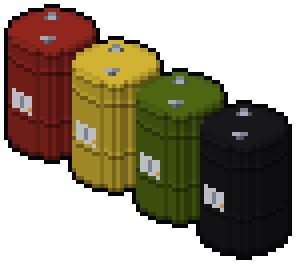
Drums and IBCs in colour
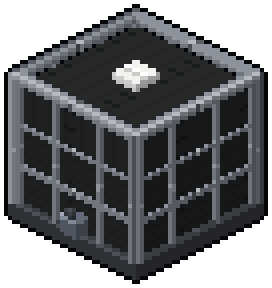
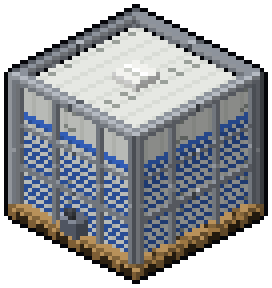
Paint a drum with any dye: red for fuel, yellow for oil, whatever your plant needs. IBCs come in white, or black with black dye, like the real ones that keep the light out. They keep their colour when you carry them away.
drum_colours.render
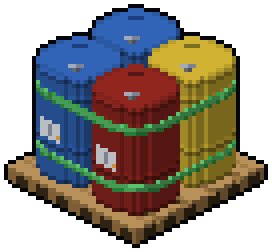
Drums on a pallet
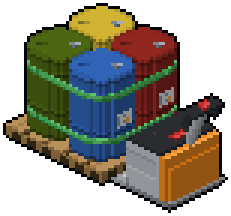
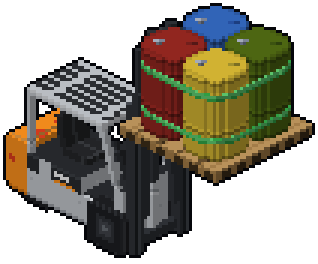
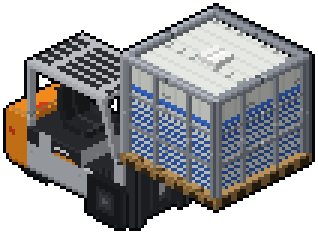
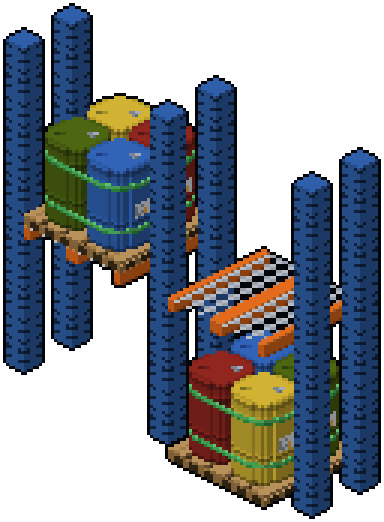
Load up to four drums on a wooden pallet and they become one load, held together by a green strap. Three drums stand in a triangle. Each keeps its liquid and colour. An IBC fits on an empty pallet too: it stands on the wood instead of its own base. Move a whole pallet with the electric pallet truck: take its tiller and it follows you, back it into a pallet and it lifts it, CTRL sets it down, and it honks for as long as you hold H. Or drive the electric forklift: it steers with its rear wheels like the real thing, and the arrow keys take the forks up to six blocks high. Lower the forks to a pallet, drive in and raise; lower it onto the ground or onto anything solid up high and it stays there. For a real warehouse there is pallet racking: blue uprights with orange beams between them; the forklift sets a pallet down on the beams and takes it off again.
pallets.render
Gases
Gas is counted like liquid, in mB, but at 1 bar, the way a real plant counts normal cubic metres. Squeeze more into the same room and the pressure goes up: twice the gas, twice the bar. Gas needs no pump: it flows by itself from high pressure to low, through steel gas pipes with a yellow band, to everything on the line. Gas pipes never join liquid pipes or tanks.
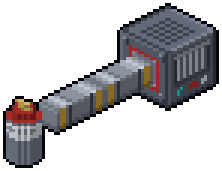
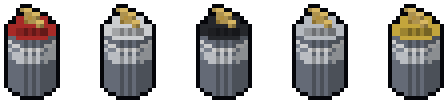
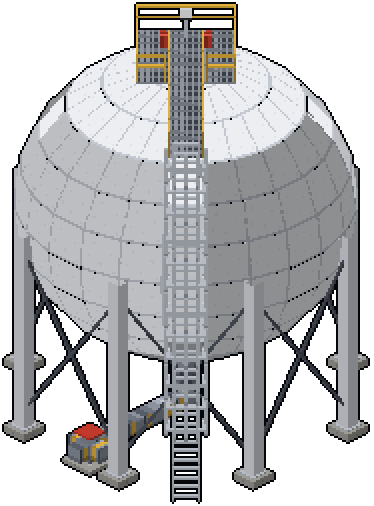
There are four gases so far. The electrolyser splits water into hydrogen and oxygen, two to one. The nitrogen generator takes nitrogen out of the air. The boiler now lets its steam out through a gas pipe on top, so a turbine can stand anywhere on the steam line. A gas cylinder holds any one gas up to 200 bar, its shoulder in the colour of the gas, like real cylinders: red hydrogen, white oxygen, black nitrogen, yellow ammonia. For a lot of gas there is the gas sphere: a round pressure vessel on eight columns with cross bracing, like the spheres that hold propane and hydrogen on a real plant. It takes eight by eight blocks, stands ten high and holds up to 3520 B of gas at 16 bar. Gas pipes join its valve station at the front; climb the caged ladder in the corner and cross the bridge to the safety valves on top. To go past 10 bar there is the gas compressor: it draws from the suction line and pushes up to 200 bar into the discharge line, enough to fill the sphere to 16 bar or a cylinder to the top. The denser the gas coming in, the more it moves; the harder it squeezes, the more power it takes, as on a real compressor.
And what the gases are for. A fuel cell turns hydrogen and oxygen back into power and water: with an electrolyser and a gas sphere you store power for later. Oxygen piped into the back of a boiler makes its coal last half as long again. The ammonia reactor turns nitrogen and hydrogen into ammonia, the fifth gas, and like a real Haber-Bosch converter it wants pressure: full speed at 100 bar, so a compressor on its feed pays off. A fertilizer mixer makes NPK fertilizer from ammonia and bone meal, and that grows every crop in a three by three up at once.
gases.render
Oil: from the well to diesel
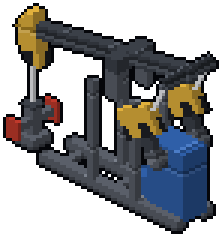
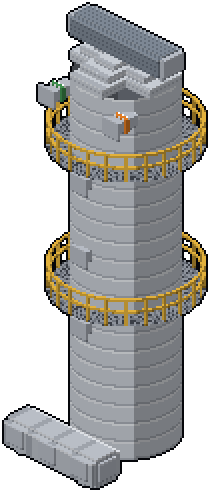
A pumpjack nods on its well anywhere you put it and pumps crude oil out of the ground, slowly and for ever. The distillation column splits that crude oil like a real crude unit: steam heats it in the reboiler, the vapour rises up the column, the condenser on top cools it with water, and each part comes out where it boils: LPG (a gas) at the top, then naphtha, kerosene and diesel, and the heavy residue at the bottom. Every nozzle has the colour of what flows through it. Diesel runs the diesel generator, the strongest power in the mod. Crude oil and naphtha give off vapour in an ordinary tank: blanket them with nitrogen from a gas pipe on top, or keep them in a floating roof tank.
oil.render
The flare: the tallest thing on the plant
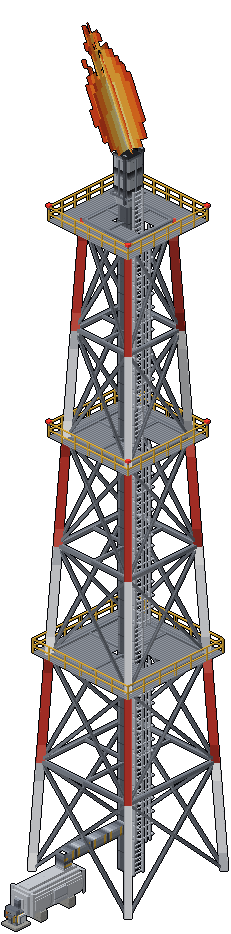
Every plant burns the gas it cannot keep, and so does yours. The flare stack is a steel riser forty blocks high in a derrick, a lattice tower that narrows towards the top, banded red and white for aircraft, with red lights on its upper platforms. You place it with one block: the ignition panel, with the knock-out drum behind it and the tower behind that. Three gas lines join the panel: the flare header at the front, pilot gas on the left (a little LPG or hydrogen keeps the pilot flame alight) and steam on the right. Right-click to light it.
Gas reaches the flare two ways. A safety valve with a gas pipe on its outlet now blows off into the flare header instead of into the air. And the flare takes the excess off every vessel on its header above its set pressure, so a distillation column whose LPG has nowhere to go keeps running. Hydrogen, ammonia and LPG burn: the more gas, the bigger the flame, up to sixteen blocks of fire that leans with the wind and lights up the night. LPG burns sooty, so blow steam into the flame; without enough steam the flare smokes black. Without pilot gas the flame goes out when nothing flows, and gas that comes then goes up unburnt: FLARE OUT on the console. Climb the caged ladder up the inside to the platforms; the top one is right under the tip.
flare_stack.render
A tank farm tank
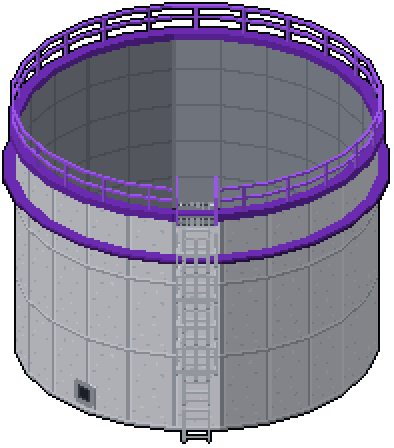
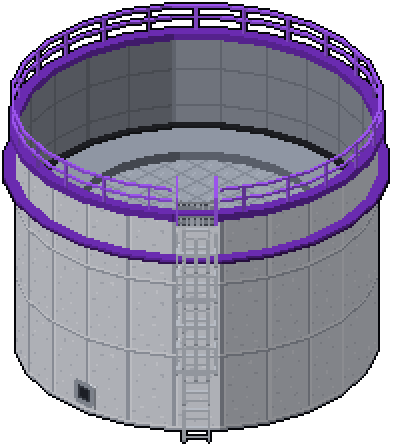
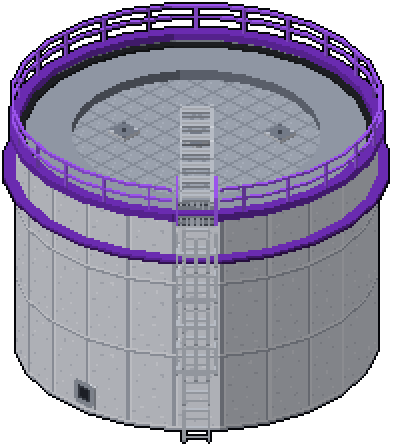
For big storage there is the floating roof tank, the first machine built from Hookonium. It is round, eight blocks across and six high, and holds 8000 buckets. You place it with one block. Its top is open: the roof is a steel deck on a ring of pontoons that floats on the liquid, so it rises as the tank fills and sinks as it empties. You read the level from the rim, and you can walk on the roof. Climb the caged ladder in the corner to the platform; the rolling ladder takes you down to the roof and swings steeper the lower it floats. Walk into a ladder to climb it. The roof moves slowly: about a pixel for every hundred buckets.
floating_roof_tank.render
Build the plant round it
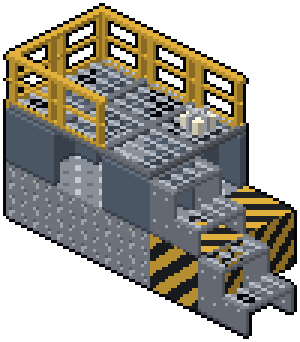
Factory blocks to build platforms, stairs and halls round your machines: steel grating (the platform of the gas sphere), open grating stairs, yellow handrails, a caged ladder, steel I-beams, checker plate, hazard stripes, corrugated steel and an industrial lamp. For a walkway: I-beams as columns, grating on top of them, and handrails in the same blocks as the grating.
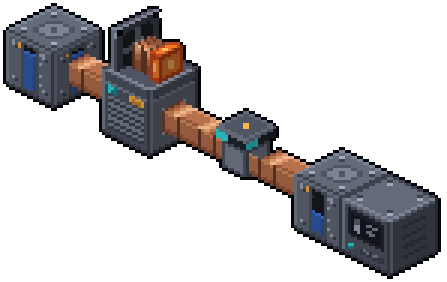
factory_blocks.render
A real control room
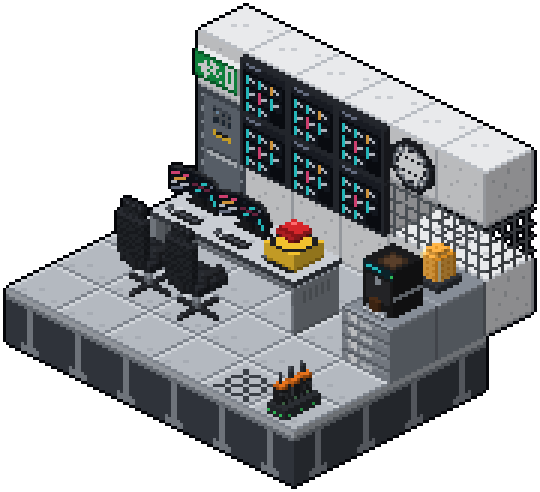
Everything to build the control room round your DCS console. Overview screens make a video wall of up to eight by six blocks that shows what the nearest console sees: a tile for every tag, the alarm list, the trends, the P&ID or the power; right-click to switch page. An amber alarm beacon turns and sounds its horn while an alarm waits for an ACK. The emergency stop (ESD) is a red mushroom button: push it in and every pump, compressor, generator, boiler and machine within 32 blocks stops at once and stays stopped until you pull it out, with ESD on the console for each of them. Pick a radio from the charger and the field operator calls in what runs and what needs a look.
And the room itself: control desks that join into one long desk, with a corner piece to turn the row, operator screens on the desks, a 24-hour chair you sit in, a raised floor with vent tiles, ceiling panels and ceiling lights, a wall clock with the time of day, a filing cabinet that stores as much as a barrel, a printer, a coffee machine (a cup gives a minute of speed and haste), a lit emergency exit sign, a blast door, and wired glass for the windows onto the plant.
control_room.render
Liquid runs downhill
Join two tanks with a pipe and the fuller one runs into the other until both stand at the same level, no pump needed: communicating vessels, like a real plant. A higher difference and a shorter, wider-open line run faster.
gravity_line.render
Overflow: a tank only lets liquid out while its level is above the pipe, so a pipe on a higher block of a tall tank is its overflow.
From the river: a water intake feeds a lower tank by itself.
Control: put a control valve in a gravity line and a controller against the low tank; it finds the valve and holds the level.
One way: a check valve lets liquid through only the way its arrow points.
// 06 ores
Ores
New ores to find, from the least rare to the most rare. Hover any item to see its name.
// 07 power
Making power
Pumps run on FE (Forge Energy), so they also work with power from other mods. Setpoint brings its own generators, from simple to serious. Each step up is better but never required, and everything is made from normal vanilla materials. No grind.
Generator
Fuel
Output
Status
Stirling engine
anything that burns in a furnace (coal is the sensible one)
20 FE/t
works
Biogas generator
anything a composter takes, plus rotten flesh
30 FE/t
works
Steam turbine
steam from a coal-fired boiler with feed water
60 FE/t
new
Diesel generator
diesel from your own distillation column
80 FE/t
late game
Wind turbine
the wind: more in rain and storms, a little more higher up
up to 100 FE/t
new
A pump uses 4 to about 20 FE/t, depending on how hard it works, so one Stirling engine runs one pump. Generators hold 20,000 FE, push power into every block they touch and only burn fuel while there is room in that buffer. No fuel gets wasted while the plant is idle. Hoppers can feed them.
A machine that does not touch a generator gets its power through a power cable. Cables join each other and every block that gives or takes FE, from Setpoint or another mod. A cable stores nothing: what a generator pushes in goes straight on to the machines along it, shared out evenly. It also pulls FE out of generators beside it, for other mods' generators that wait to be drained instead of pushing. Water flows round it, so you can bury it.
A battery bank keeps what the machines leave over, a million FE of it, and gives it back when they need more than the generators make: wind power for a calm. A power meter in the cable shows how much FE flows, and the video wall has a POWER page with all of it at a glance.
Steam: three times more power per coal
steam_plant.render
Place a boiler and put coal in its firebox. Click it with a few water buckets to get going.
Put a steam turbine against it, on top or on any side. It spins up as soon as the water boils.
Feed it water. A boiler uses 20 mB of water per tick, so for long runs pump it in from a water intake or a tank, with a control valve in the line.
Add drum level control. Put a DCS controller against the boiler. It finds the feed valve and holds the drum at 50 %, just like a tank.
SAFETYIf the drum level drops below 10 %, the burner trips and waits until the level is back above 25 %. A boiler can never run dry, unless a server admin switches that protection off in the config (boiler.lowLevelTrip). Then a dry drum glows red hot and bursts, and feeding water into a red-hot drum is even worse.
Pressure: steam in a closed drum
A boiler keeps its steam in a closed drum, so the steam builds pressure: 400 mB of steam is one bar. The turbine wants 6 bar for full power and takes less steam below that. The drum is built for 10 bar.
pressure_plant.render
When the turbine stops taking steam, because its power has nowhere to go, the pressure climbs. Like on a real plant, three layers stand between you and a burst drum:
Control. Put a pressure transmitter against the boiler and a DCS controller against the transmitter. It becomes a PIC: it holds the pressure by turning the burner up and down. At part fire the coal lasts longer.
The trip. At 9 bar the burner stops, and starts again at 7 bar. On by default (boiler.highPressureTrip).
The safety valve. On the drum, it pops open at 10 bar and blows off steam faster than the boiler can make it, until the pressure is a bar lower.
DANGERWith the trip switched off and no safety valve, nothing stops the pressure. Above 11 bar the drum groans; at 13 bar it bursts.
// 08 screens
Machine screens
Machines that take items open a screen like a furnace: a slot for the items, a gauge and a small display in plain words. Below are the in-game layouts, redrawn for the web.
Stirling engine: fuel slot, flame, status and FE buffer
Tank: bucket in at the top, empty bucket out below, live level
Boiler: firebox slot, drum level with its trip mark, pressure, temperature, and a pressure gauge marked at 9 and 10 bar
DCS console: click the tabs, click a tag to trend it, and press ACK to silence the alarm. Example plant.
// 09 try it
Faceplate demo
This is the DCS controller's faceplate, and it is live. A valve fills the tank, a drain empties it, and the controller holds the level. Change the setpoint, open the drain, switch to MAN, or flip the action and watch what happens.
LIC-101 trendPVSPvalve
Simulation runs 8x faster than in game. In game, the DCS console keeps trends like this one for every tag.
// 10 under the hood
For the curious
None of this is needed to play. It is what makes the machines behave the way they do.
Pump curve
Each pump has a real curve: 12 m of head with the discharge shut, up to 120 mB/t when it runs free. Long pipes add friction, so the flow settles where the pump curve meets the pipe curve.
Cavitation
The pump needs enough pressure at its suction (NPSH). Pull from a tank that is lower down, or through a long suction line, and it starts to cavitate: it crackles, loses flow and wears its impeller. An iron ingot buys a new one.
Control valves
A valve strokes at 20 % per second. Sneak-click it to choose what it does when it loses its signal or gets a redstone trip: fail close (FC) or fail open (FO). An open valve hardly slows the flow; a nearly closed one chokes it.
PID control
The controller runs a real PI loop with three tunings: SLOW, NORMAL and FAST. It picks reverse or direct action itself, based on whether the valve fills or empties its tank. HI and LO alarms default to 90 % and 10 %.
Modes
MAN: you set the valve yourself. AUTO: the controller holds its setpoint. CAS: another controller sets the setpoint for this one. If the measurement goes bad, the controller drops to MAN on its own, just like a real DCS.
Boiler and turbine
Water heats at 0.4 °C per tick until it boils; from then on every tick of firing turns 20 mB of water into steam. The turbine rotor has inertia: it takes a few seconds to reach 3000 rpm, and makes less power while it spins up.
Pressure
Every 400 mB of steam in the drum is one bar. The turbine inlet passes its full 20 mB/t from 6 bar up and less below, so a plant starts up smoothly. A safety valve vents 60 mB/t, three boilers' worth, and shuts again a bar below its set pressure (the blowdown).
Tall tanks
Stacked tanks share one level. Liquid settles to the bottom, fills from the bottom up and is drawn from the top down. A suction line on a tank above the liquid gets air, just like the real thing.
Flow control
A flow loop is the second kind of loop next to level. Every pump that pumps through a flow transmitter reports its flow to it; the controller moves the valve in the same line to hold the setpoint. Flow loops answer fast, so they suit the FAST tuning.
Mimic board
The top-left board of a panel holds the P&ID and reads the plant once a second, like a console. Players nearby get the state of every tag and paint the drawing into a texture, the way a map is drawn, 64 pixels per block. Clicking works out which symbol you hit from where you aimed on the panel.
Gravity
A tank looks down every pipe that leaves it. If the vessel at the other end stands lower, liquid runs: the level difference equals the pipe friction times the flow squared, the same pipe physics as a pump line. Near the same level only a trickle runs, so the levels meet instead of sloshing. Pipes leave a tank low on the side of a block.
Any liquid
Pumps read how heavy and how thick a liquid is from the game itself. Lava is three times as heavy as water, so it costs three times the power to lift and the air pushes it only 3.4 m up a suction line; it is six times as thick, so the pipes slow it down. Modded liquids bring their own numbers.
Other mods
Pumps, controllers and level transmitters work with any block that stores fluid, from other mods or a vanilla cauldron. Storage that only takes whole buckets is filled a bucket at a time.
Oil is oil: crude oil, diesel, kerosene and naphtha sit in the common tags (c:crude_oil, c:diesel, c:kerosene, c:naphtha, the names PneumaticCraft uses too), so the column, the diesel generator and the burner take other mods' oils, and their machines take Setpoint's. Steam is c:steam, LPG c:lpg, the gases c:gaseous. The vehicle keys only count while you drive, so they never clash with another mod's keys.
Alarm handling
The console runs its alarm list like a real DCS. A new alarm is NEW until you acknowledge it. Acknowledged, it stays while the problem lasts. If the problem goes away before anyone looked, it stays as RTN (returned to normal) until acknowledged, so nothing slips by unseen.
Config
For server admins and modpack makers, in the world config: boiler protection (boiler.lowLevelTrip, boiler.highPressureTrip, both on), the free handbook (handbook.giveOnFirstJoin), what each generator makes at full output (power.stirlingEngine, biogasGenerator, steamTurbine, dieselGenerator, fuelCell, windTurbine, in FE/t) and whether /setpoint showcase may be used (showcase.allowCommand). In the startup config, worldgen.hookoniumOre switches the ore off for packs that give Hookonium another way. JEI, the console and Jade show the numbers you set.
Field communicator
For manual wiring: sneak-click transmitters and valves to collect them, then click a controller to link them. Tags become loop numbers like LT-203 and LV-203. Rename any instrument with a name tag.
// 11 roadmap
What is coming
DONE
M1 · First machine
Pipes, tank and a centrifugal pump that cavitates when you starve it.
DONE
M2 · Control
Control valve, level transmitter, DCS controller with faceplate, field communicator.
DONE
Power 1 · Stirling and biogas
The first generators, with furnace-style screens.
DONE
Power 2 · Steam
A coal-fired boiler and a steam turbine, with drum level control and a low-level trip.
DONE
M3 · Control room
The DCS console: an overview of the whole plant, five-minute trends, an alarm list with acknowledge, and faceplates from the console.
DONE
Ore · Hookonium
A purple endgame ore, as rare as diamond.
DONE
M4 · Pressure
Boiler pressure, a high-pressure trip, the safety valve, the pressure transmitter and boiler pressure control (PIC). And what happens when you ignore them.
DONE
Foundations · Help
The in-game handbook, tooltips, an advancement learning path, comparator output and Jade support.
DONE
Foundations · Piping
Water intake, hand valve, pipe wrench, running sounds and three more advancements.
DONE
Foundations · Tanks and flow
Tall tanks, flow control, other mods' tanks, and new Hookonium art.
DONE
Foundations · Basics
Your own equipment tags with a name tag, a drain valve, and a pump that can run on a redstone signal.
DONE
Foundations · Every liquid
Lava and other mods' liquids with their own weight and thickness, and a sight glass in their colour.
DONE
Foundations · Gravity
Liquid runs downhill between tanks, overflows, gravity-fed level control and the check valve.
DONE
Gases · Flare stack
A flare forty blocks high in a red and white derrick: a pilot flame, a flame as big as the gas it burns, steam against smoke, and safety valves that blow off into its header.
DONE
Control room 2 · A real control room
Overview screens as a video wall, an alarm beacon with a horn, the emergency stop, radios to the field, and the furniture: desks, operator screens, a 24-hour chair, raised floor, ceiling, clock, filing cabinet, coffee, exit sign, blast door and wired glass.
DONE
Core · P&IDs
Draw any plant as a P&ID: blank sheets, a selection box in the world, named blueprints with standard symbols and signal lines.
NOW
Core · P&IDs in the game
Putting the drawings to work. Done: a P&ID in the DCS console shows your plant live, and P&ID boards put it big on the wall, where you can work the plant from. More to come.
NOW
Foundations
Making the base of the mod complete and solid before anything big and new.
NOW
Logistics
Drums, IBCs, pallets, an electric pallet truck, a forklift you drive and pallet racking are in.
NOW
Gases
Hydrogen, oxygen, nitrogen and steam, with pressure, gas pipes, an electrolyser, a nitrogen generator, gas cylinders, the gas sphere, a compressor, a fuel cell, oxygen for the boiler, ammonia with fertilizer and a nitrogen blanket for oil tanks are in.
DONE
M5 · Distillation
A pumpjack for crude oil and a distillation column with reboiler and condenser: LPG, naphtha, kerosene, diesel and residue.
DONE
Power 3 · Diesel
A diesel generator that runs on diesel from your own column.
DONE
Power 4 · Wind and cables
A wind turbine thirty blocks high that makes power from the weather, and power cables to bring FE to machines that do not touch a generator.
NOW
Endgame · Hookonium machines
The first is in: a floating roof tank for 8000 buckets. Ideas for later: a stronger pump, a wireless controller, a reactor with its own control loop.